A slow restaurant website can make a simple task frustrating. Someone might be trying to check a menu, book a table, find opening hours or decide where to eat, and if the website takes too long to respond, they may look elsewhere.
Website speed is about more than how quickly a page appears. Hosting, caching, booking tools, forms, plugins and the order in which different parts of a page load can all affect how quickly someone can actually use a website.
We looked at five restaurant websites and checked them using Google PageSpeed Insights. Some performed very strongly, while others showed areas that could still be improved. That makes them useful examples for small business owners who want to know what can make a website feel quick and easy to use.
These websites are not ranked from fastest to slowest. Instead, each one shows a different part of website performance.
At Fly High Web, our advice is to find out what is causing the wait before spending money on a fix. A slow website does not always mean you need a new one.
Why Website Speed Matters for Restaurants
Restaurant customers usually visit a website for a simple reason. They may want to see the menu, check opening hours, book a table, find the restaurant or get in touch.
Those actions should be easy and quick.
A website can appear on screen but still feel slow if a booking button takes too long to react, a form hangs after someone presses submit or the main part of the page takes several seconds to appear.
Restaurant websites can change often too. Menus get updated, booking systems change, new plugins are added and seasonal content comes and goes.
That means website speed is something worth checking over time, not just when the site first goes live.
How We Chose the Websites for This List
We looked at five restaurant and hospitality websites:
We then compared the results from Google PageSpeed Insights.
The aim was not to find five identical websites. Some are simpler, while others have booking systems, several menus and more changing content.
That makes them useful examples for looking at hosting, caching, extra tools, loading order, buttons, forms and ongoing maintenance.
If you would prefer help looking after those checks, our WordPress maintenance services can help you keep on top of your website’s care.
1. Planaterra Bar in Chester
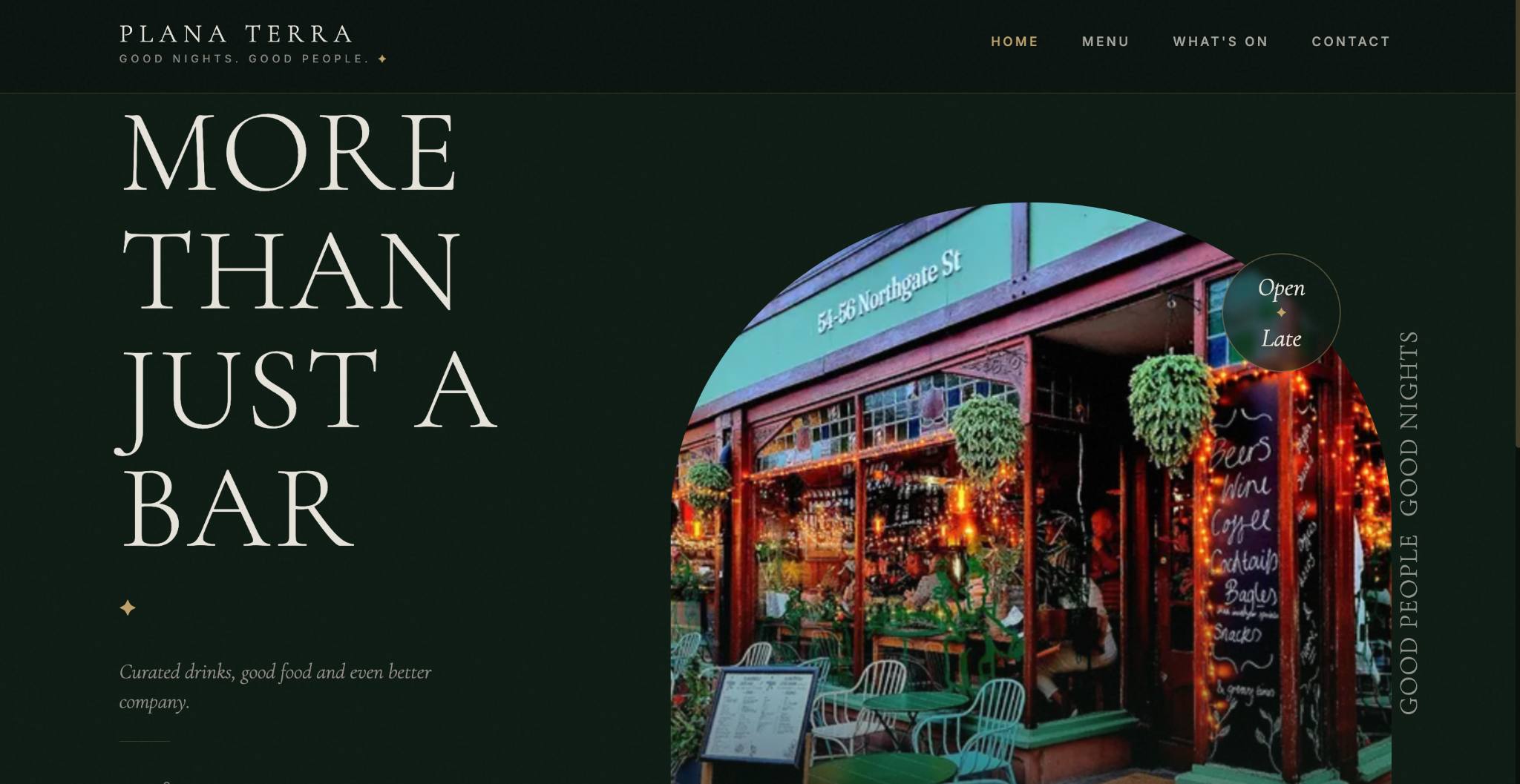
Planaterra Bar in Chester is a great example of a restaurant website that uses large, high-quality photography without making visitors wait around for the page to load.
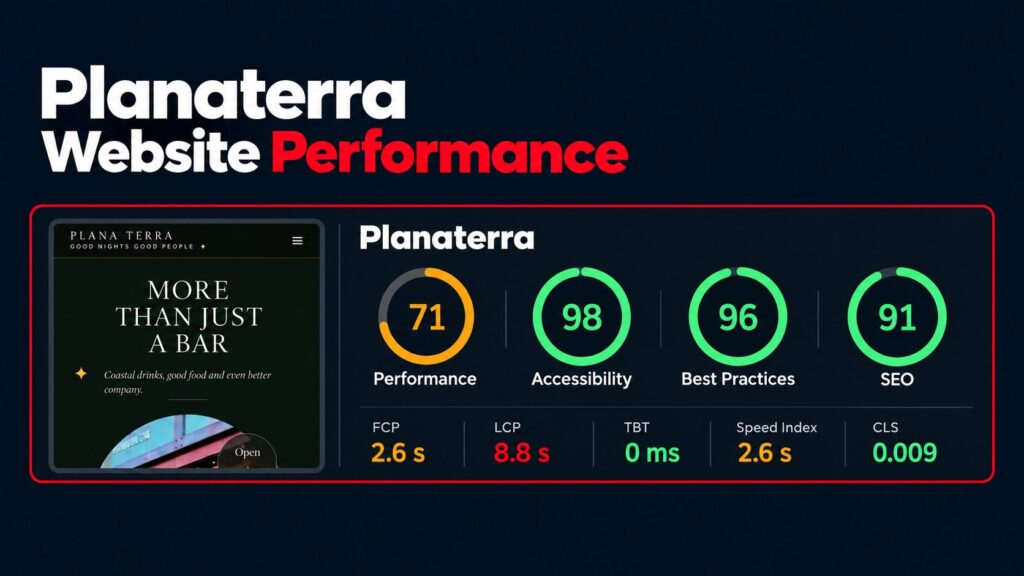
In our Google PageSpeed Insights test, the website achieved an impressive 94/100 performance score on desktop. The first content appeared in just 0.7 seconds, while the largest piece of visible content loaded in 1.6 seconds. For someone visiting the site to look at the venue, find information or decide whether to visit, that creates a noticeably quick experience.
Why Is Planaterra’s Website So Fast?
A major reason is that the website is not making the browser do lots of work before it can show the page. Google recorded a Total Blocking Time of 0 milliseconds on both desktop and mobile. In simple terms, there are no significant periods where the website is so busy processing code that it cannot respond properly. This helps pages appear and become usable quickly.
The website also loads its most important visible content quickly. On desktop, the largest element visitors initially see was loaded within 1.6 seconds. Rather than making someone wait for the main image or section of the page to appear, Planaterra gets the important parts of its design onto the screen early.
Another strength is how stable the page is as it loads. Planaterra recorded a Cumulative Layout Shift score of 0. This means images, text and buttons stay where they are supposed to be instead of moving around while additional parts of the website load. It might not directly make the internet connection faster, but it makes the website feel much faster and smoother to the person using it.
This is particularly important for Planaterra because its website is very image-led. Restaurants naturally want to use large photographs to show off their food, drinks and venue, but poorly handled images can be one of the biggest causes of slow restaurant websites. Planaterra manages to deliver this visually rich design while still achieving excellent desktop loading times.
There are still improvements that could be made. Google identified opportunities around image delivery, browser caching, render-blocking resources and unused JavaScript, which help explain why its mobile performance score is 68/100 rather than matching the 94/100 achieved on desktop.
2. Little Yellow Pig in Chester
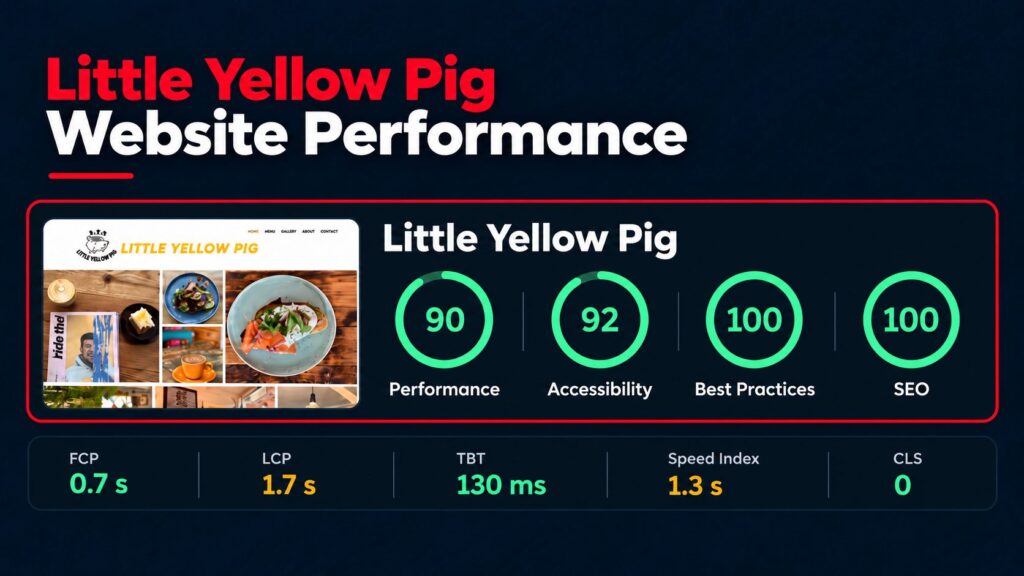
Little Yellow Pig is another strong example of a small hospitality website that keeps things quick without making the site feel overly basic.
In our Google PageSpeed Insights test, Little Yellow Pig achieved a 90/100 desktop performance score. The first content appeared in 0.7 seconds, while the largest main section of the page loaded in 1.7 seconds. Its overall Speed Index was 1.3 seconds, meaning the visible parts of the page appeared quickly for someone arriving on the site.
For a customer wanting to find a location, check opening information or look at what the business offers, those are strong results.
Why Is Little Yellow Pig’s Website So Fast?
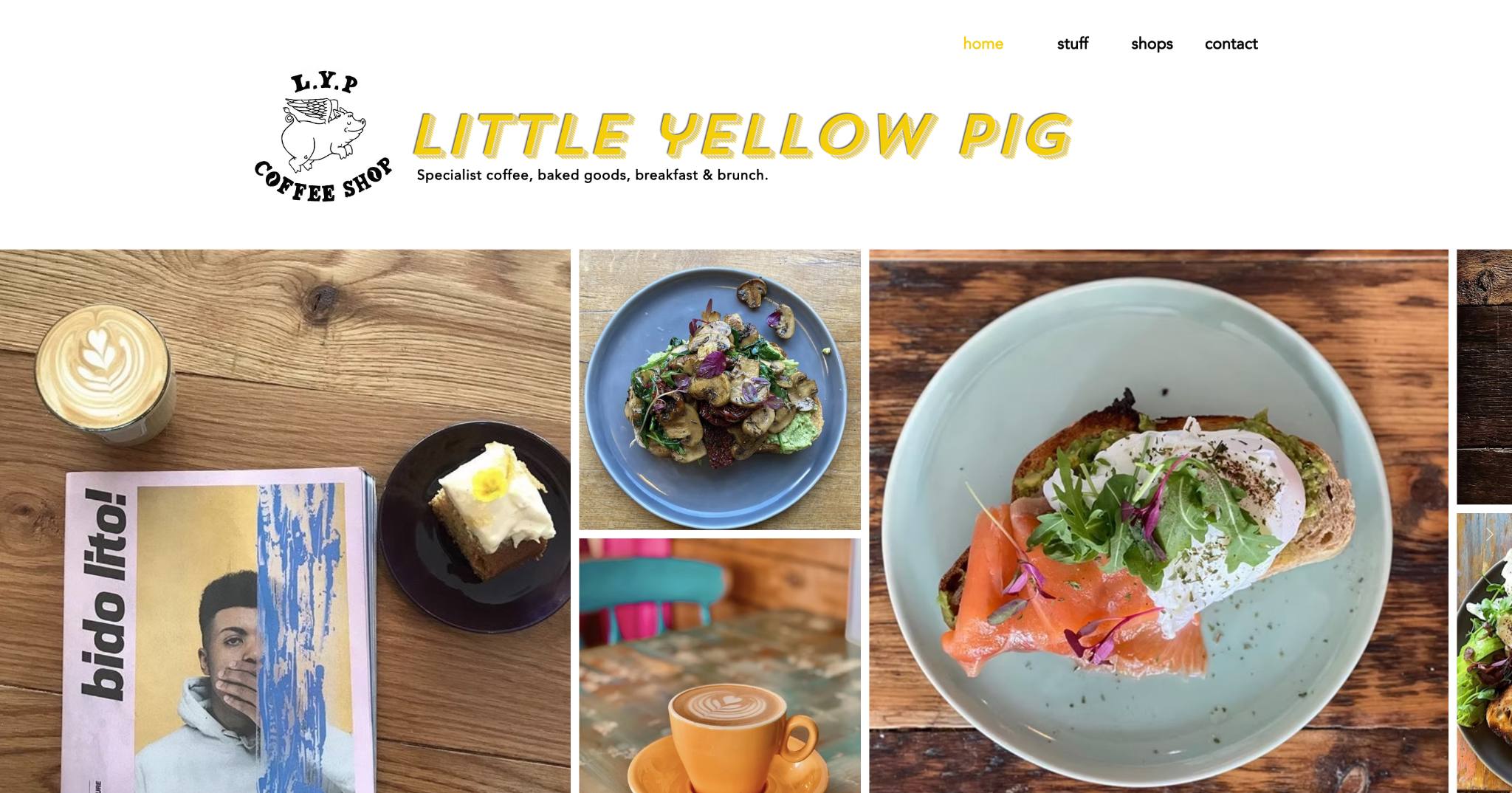
One of the biggest strengths is that the page starts showing information very quickly. Google recorded a First Contentful Paint of 0.7 seconds, so visitors are not left staring at a blank screen before the website begins to appear.
The main visible content also loads fairly quickly at 1.7 seconds. This means the website is getting the important part of the page onto the screen without making customers wait for lots of other things first.
Little Yellow Pig also recorded a Cumulative Layout Shift score of 0. In everyday terms, the page stays where it is supposed to as it loads. Buttons, text and other sections are not jumping around unexpectedly.
Its Total Blocking Time was 130 milliseconds. This measures how long the website is too busy dealing with other work to respond properly. At 130 milliseconds, that delay is still small, so the website should feel responsive when someone starts using it.
Another useful lesson from Little Yellow Pig is the value of keeping a website focused. Restaurant and café websites can gradually collect booking tools, social feeds, pop-ups, review widgets and other extras. Each one can give the website more work to do.
A website does not need every possible feature. Keeping the things customers actually use can help the site stay easier to maintain and reduce unnecessary delays.
Google did still identify areas that could be improved, including some unused code and files that could be delivered more efficiently. That shows that even a website scoring 90/100 can still have things worth checking.
3. Moules à Go-Go in Chester
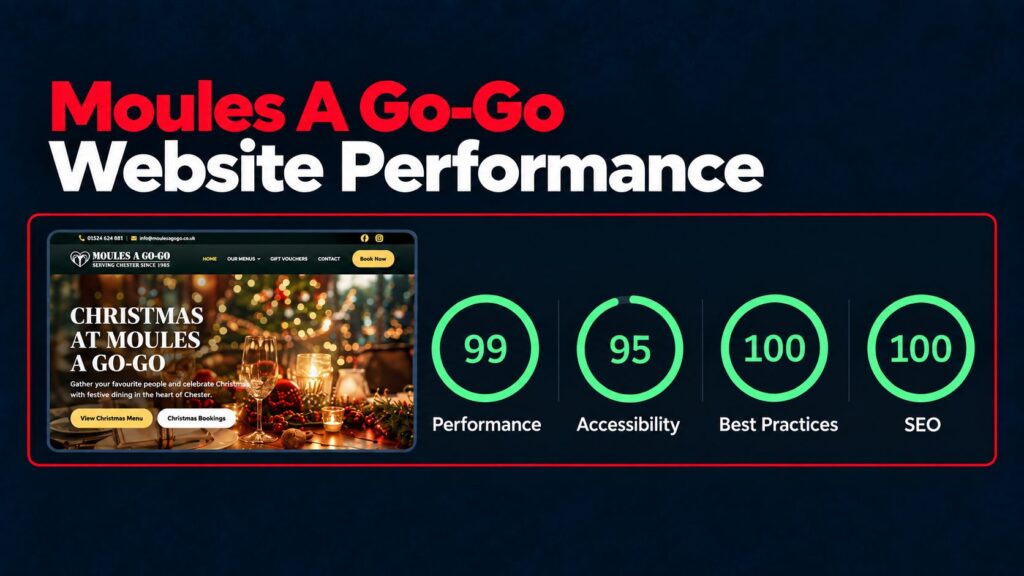
Moules à Go-Go produced one of the strongest PageSpeed Insights results in the group.
In our desktop test, the website achieved an excellent 99/100 performance score. The first content appeared in just 0.6 seconds, while the largest visible part of the page loaded in 0.9 seconds. Its Speed Index was also only 0.6 seconds, meaning visitors see the page take shape almost immediately.
For a restaurant customer wanting to look at a menu, find booking information or get contact details, that creates a very quick first impression.
Why Is Moules à Go-Go’s Website So Fast?
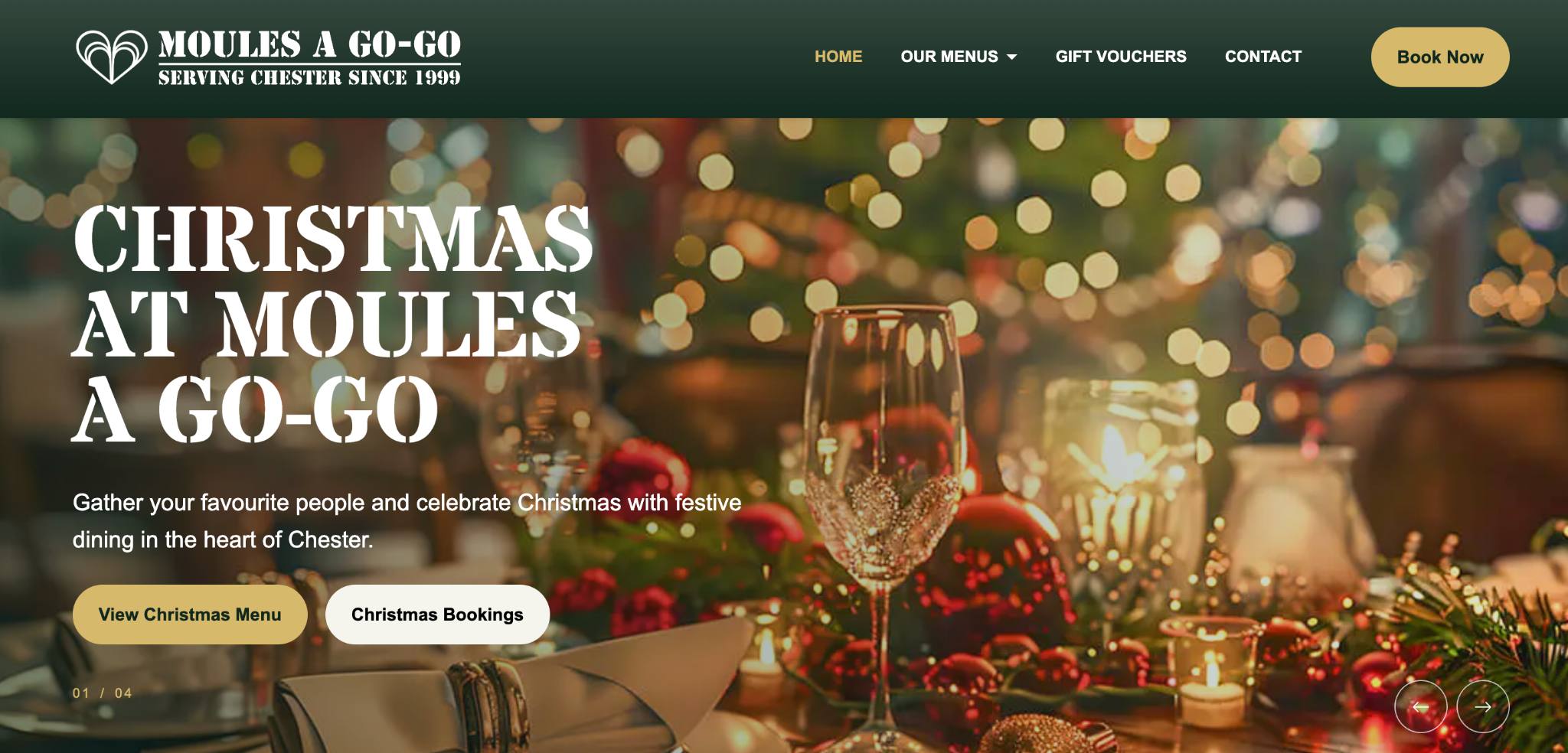
One of the strongest results is how quickly the main page content appears. The largest visible section was loaded within 0.9 seconds, which means visitors are not waiting several seconds for the main part of the website to arrive.
The website also recorded a Total Blocking Time of just 40 milliseconds. In simple terms, the website spends very little time being too busy to respond to the person using it.
That matters for restaurant websites where customers may want to press a booking button, open a menu or move to another page straight away.
Moules à Go-Go also achieved a Cumulative Layout Shift score of 0. Nothing significant is jumping around as the page loads, which makes the website feel settled almost immediately.
This combination is important. It is possible for a website to appear quickly but then feel sluggish when someone presses a button. Moules à Go-Go performs well in both areas. The page appears quickly and the website is not spending long periods tied up with background work.
Google still identified a few smaller opportunities for improvement, including some image delivery and unused code. However, these are relatively minor compared with the overall result.
A 99/100 desktop score shows that a restaurant website can include strong visual content, menus and other useful information without becoming slow or awkward to use.
4. Klais in Wirral
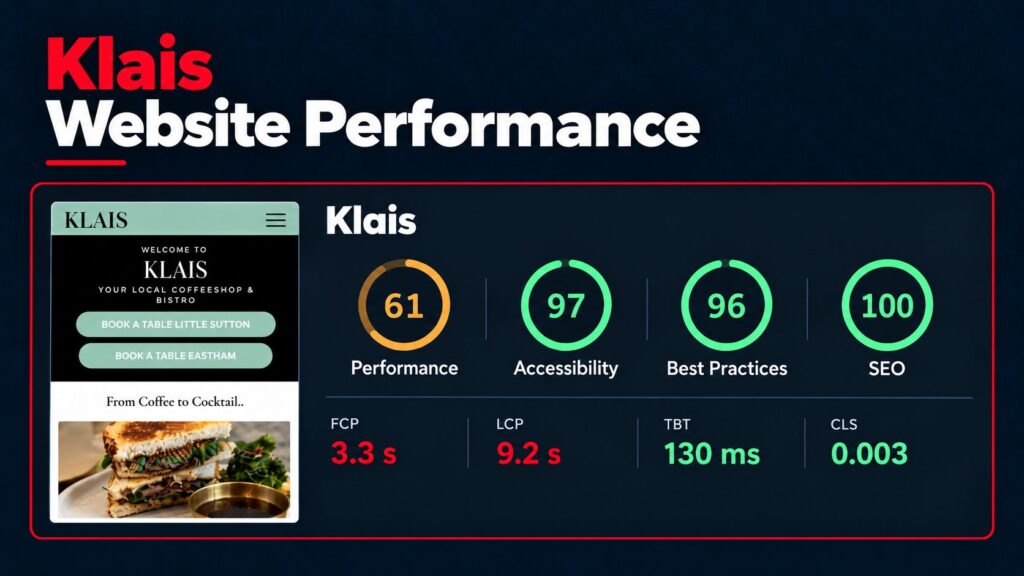
Klais is a useful example of a restaurant website that starts loading quickly and stays very stable while the page appears.
In our Google PageSpeed Insights test, Klais achieved a 67/100 desktop performance score. The first content appeared in just 0.7 seconds, while its Speed Index was 2.3 seconds. For someone opening the site to check a menu, location or booking information, the page begins showing useful content almost straight away.
Why Does Klais Still Feel Quick?
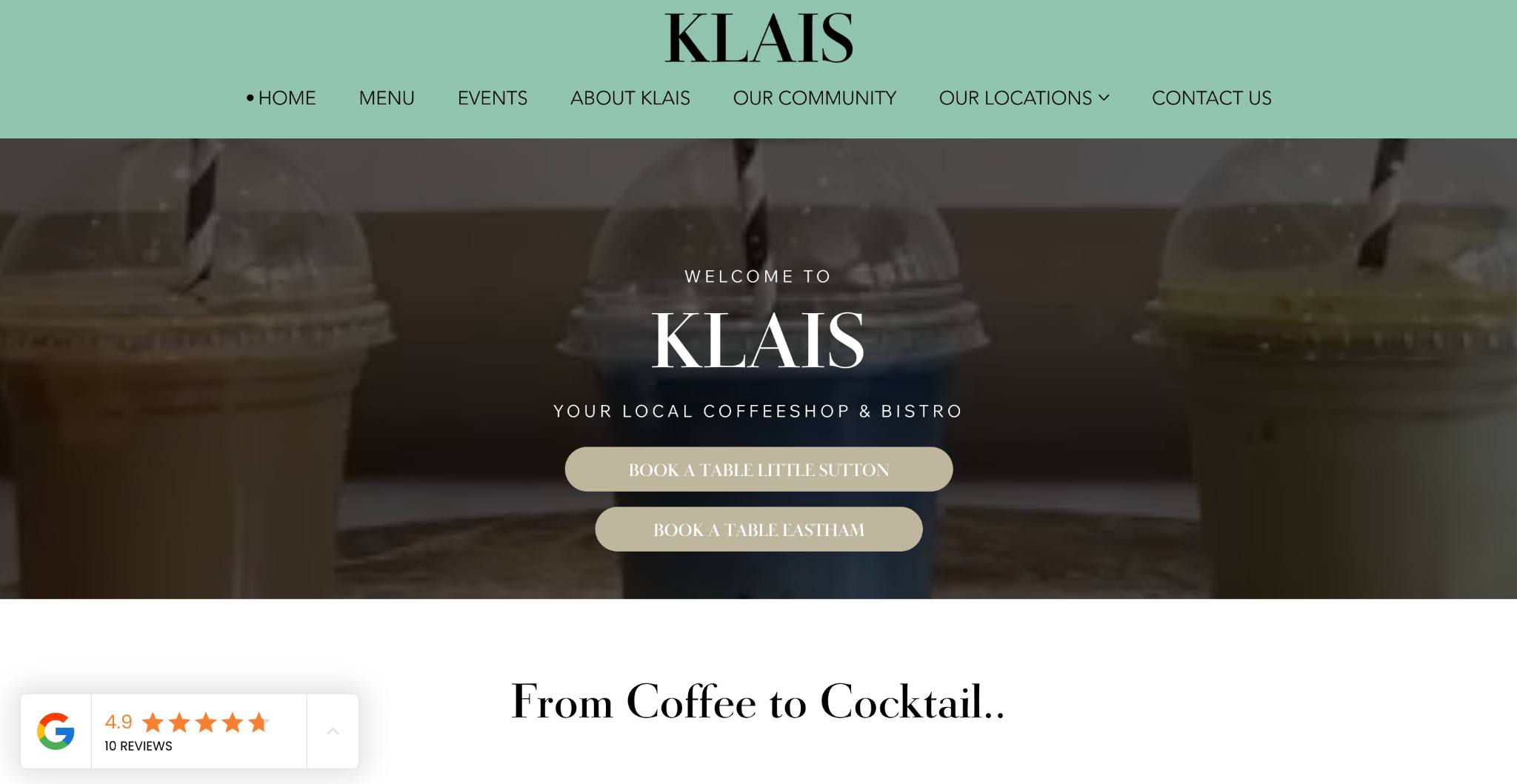
One of Klais’ strengths is how quickly the website starts to appear. Google recorded a First Contentful Paint of 0.7 seconds, so visitors are not left looking at a blank screen while the page gets ready.
The site also performs well when it comes to stability. It recorded a Cumulative Layout Shift score of 0.001, which means the page stays almost completely still as it loads. Text, buttons and other sections are not moving around unexpectedly, which makes the site feel much smoother to use.
Klais also recorded a Total Blocking Time of 150 milliseconds. In simple terms, the site is not spending long periods too busy to respond. That matters for restaurant customers who may want to open a menu, press a booking button or move to another section quickly.
The main area that could still be improved is the largest visible part of the page, which took 7.7 seconds to finish loading in our test. That does not stop the website from showing content quickly, but it does mean one of the bigger parts of the page arrives later than the rest.
This is a good example of why loading order matters. The most useful parts of a restaurant website, such as menus, location details and booking options, should appear as early as possible, with less urgent content following afterwards.
Google also identified areas where some files and page content could be loaded more efficiently. Even so, Klais performs well in several areas that affect how quick a website feels, including fast first content, low blocking time and a very stable layout.
5. Artezzan in Chester
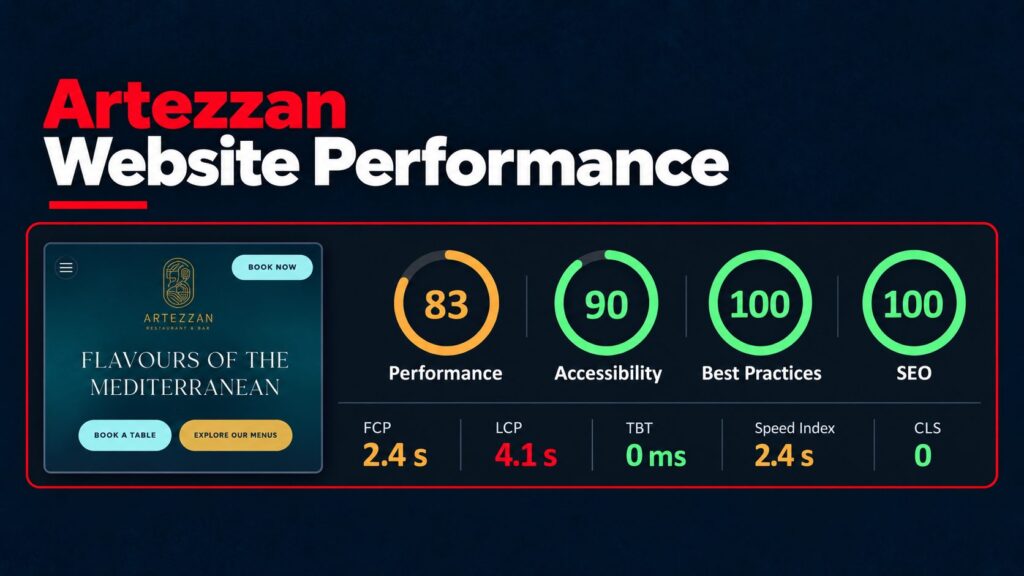
Artezzan achieved another very strong result in our Google PageSpeed Insights testing.
Its desktop performance score was 98/100. The first content appeared in just 0.6 seconds, while the largest visible part of the page loaded in 0.8 seconds.
Artezzan also recorded 0 milliseconds of Total Blocking Time and a Cumulative Layout Shift score of 0.
These figures are particularly impressive when you consider that Artezzan’s website contains several types of content, including menus, table bookings, private hire information, gift cards and seasonal updates.
Why Is Artezzan’s Website So Fast?
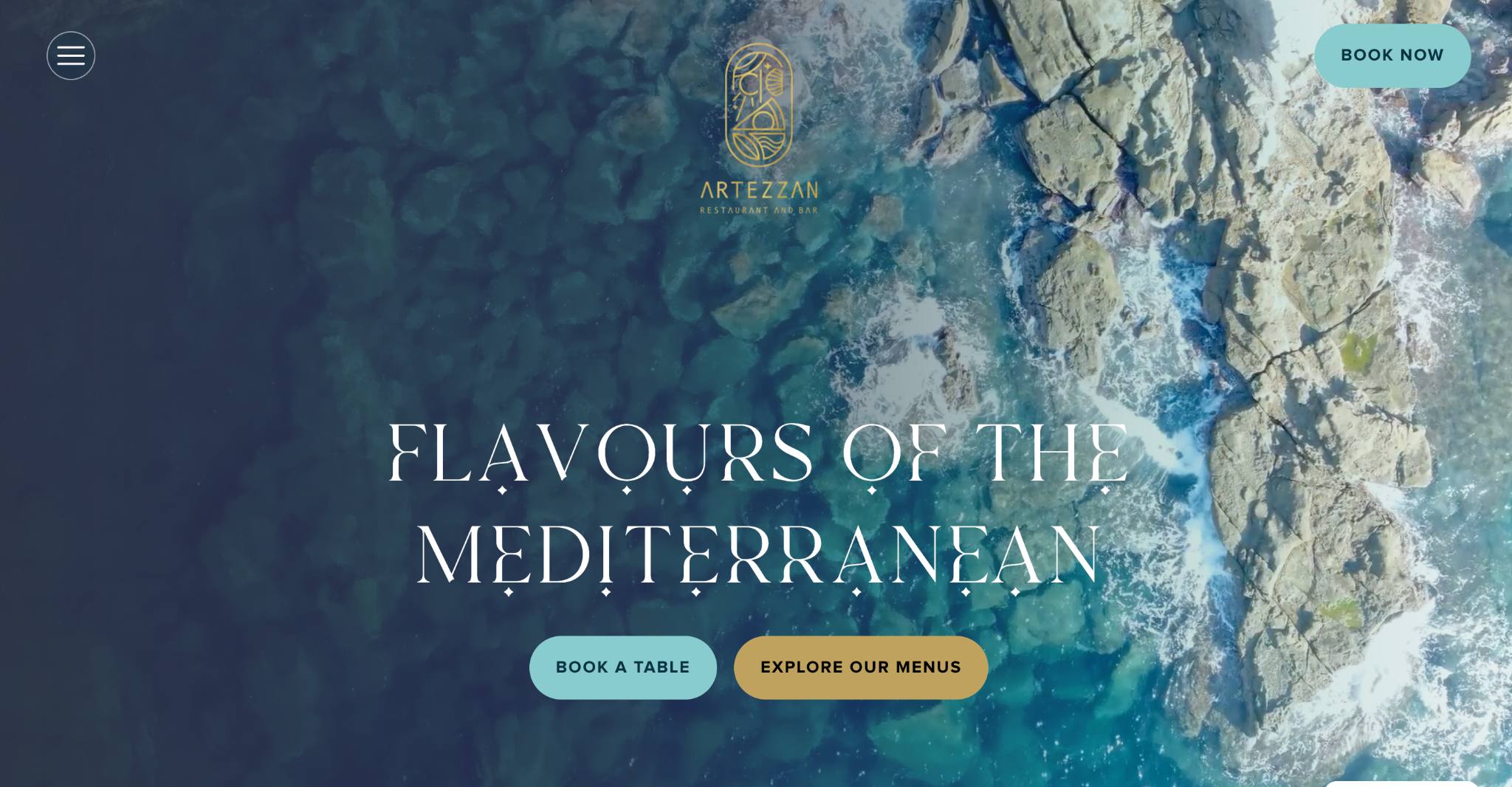
One of Artezzan’s biggest strengths is how quickly the main content becomes visible.
The largest part of the opening page was loaded within 0.8 seconds in our desktop test. That means someone visiting the website can begin seeing and using the important parts almost immediately.
Google also recorded 0 milliseconds of Total Blocking Time. In simple terms, the website is not getting tied up with background work that stops it from responding properly.
That can make a big difference on a restaurant website. Customers may want to move quickly between menus, booking information and other sections without waiting for the website to catch up.
Artezzan’s layout shift score of 0 is another positive result. Content stays in place as the page loads, rather than suddenly moving a button or piece of text after someone has already tried to use it.
Artezzan is particularly useful as an example of ongoing maintenance. Its website has more moving parts than a very simple restaurant site. Menus can change, seasonal content can be added, booking tools may be updated and new features can appear over time.
Despite that, the website still produced a 98/100 performance score in our desktop test.
Artezzan also passes Google’s Core Web Vitals assessment based on real visitor data. Its real-world figures showed the largest main content appearing in around 1.4 seconds, with interactions responding in around 121 milliseconds.
That suggests the strong PageSpeed Insights result is not limited to a single test. Real visitors are generally receiving a quick and responsive experience too.
Google did identify a few areas where the site could still be improved, including some files that could be handled more efficiently. That reinforces an important point for business owners: website performance is never really a job you finish once and forget about.
Regular checks help keep a fast website fast as the business and website continue to change.
What Do These Restaurant Websites Have in Common?
These five websites do not all have the same PageSpeed score, but they show several areas that can affect how quick a website feels to the person using it.
The main things we would look at are:
- Hosting: How quickly the website responds when someone opens a page.
- Caching: Keeping a ready-made copy of suitable pages so they can appear sooner.
- Plugins and extra tools: Checking whether booking systems, chat boxes, pop-ups and other features are adding delays.
- Loading order: Showing useful content first, with less urgent features loading later.
- Buttons and forms: Making sure the website responds quickly when somebody uses it.
- Ongoing maintenance: Checking that updates and new features have not slowed things down.
A website can look completely normal and still have a problem in one of these areas.
That is why it is better to find the cause than guess at the fix.
How to Keep Your Restaurant Website Fast
You do not need to check every page every day.
Start with the pages customers rely on most:
- Homepage
- Menu
- Booking page
- Contact page
- Online ordering
- Basket and checkout, where relevant
Open them on both a phone and computer.
Check how quickly the website starts responding, then use it properly.
Try the menu, booking system, forms and ordering process.
Look out for anything that feels slower than usual.
If a problem appears after a website update or new feature, get it checked before it becomes a bigger issue.
Keep a backup before important changes too. A backup is a saved copy of your website that can help restore it if something goes wrong.
You do not need to diagnose every issue yourself.
You need somebody who can check whether the problem is coming from hosting, caching, plugins, loading order or the features customers actually use.
Fly High Web’s free website audit can help flag areas worth checking and give you a starting point for reviewing your website.